
NMC advertising guidelines 2026, explained
The NMC advertising guidelines for doctors and hospitals in India: what you can post, what is banned, and what can happen. Made for doctors, hospital teams, marketers, students and patients. No legal background needed.
Unofficial summary. Written to make the notice easier to read. Not legal advice. Read the official notice and ask your State Medical Council if unsure.
NMC advertising guidelines in 60 seconds
On 6 October 2026 the National Medical Commission (NMC) published guidelines on ethical advertising and public communication by hospitals and registered doctors. They apply to every medium, including social media.
✓ Allowed
Facts you can check: name, qualifications, location, departments, equipment, fees. Health education. Formal announcements.
× Not allowed
“Best”, “No.1”, guarantees, patient testimonials, before-and-after photos, offers, fake followers and AI-made promotion.
? Check first
Using an agency or influencer, asking for Google reviews, and who exactly is covered. The notice is not fully clear on these.
What is at stake
Penalties run from a warning to removal from the medical register for 1 to 3 years for repeat offences.
Who do the NMC advertising guidelines cover?
Registered Medical Practitioners (doctors listed in the National or a State Medical Register) and hospitals and clinical establishments. From the notice
It does not matter where the message appears. If it promotes a doctor or a hospital, the guidelines apply. That includes:
Reading this as a patient, journalist or student? This is why you may see fewer “best doctor” claims, patient stories and festival-offer posts from hospitals and clinics from now on, and more plain health information and facts such as departments, equipment and fees.
Can I post this? A 30-second checker
Tap what you want to post. You get a plain answer, the clause it comes from, and what to do instead. This is a reading aid, so when the answer says “check first”, check first.
What do you want to post?
Pick a post idea above and Melo will tell you what the guidelines say.
Do's and don'ts for doctors and hospitals
The whole notice on one screen. Clause numbers in brackets are from the official document. The allowed categories sit in clauses 5.1, 8.2, 8.3 and 9.1.
✓ Do
- Share factual, checkable information: name, location, contact details, departments, equipment, accreditation, emergency services
- Publish health education that helps people and does not promote you
- Announce starting practice, a change of address or type of practice, a temporary absence, a return, and your consultation fees
- List your doctors on a hospital website with names, recognised qualifications, specialties, registration details and availability
- Mark AI-assisted content clearly as AI-made(7.2)
× Don't
- Use “Best”, “No.1”, “100% success”, “painless”, “guaranteed cure” or similarUnless objectively verifiable (8.1(iii))
- Request or share patient testimonials, endorsements or reviews for promotion on social mediaExpl. V to 3.2, 8.1(xi)
- Post before-and-after photos, surgical results or celebrity-patient storiesOnly scientific or educational use with anonymised consent (8.1(v))
- Run discounts, contests, coupons, gifts, cashbacks or free procedures that could encourage unnecessary treatment(8.1(x))
- Buy followers, likes, comments or reviews, or manipulate search rankings or algorithms to mislead(8.1(xii))
- Engage a third party for marketing medical services, or pay an agency per patient(8.1(ii), 8.1(viii))
- Share anything that identifies a patient: names, faces, recordsConsent alone does not make a banned practice allowed (6.1 to 6.4, 7.4)
- Use AI to create promotional campaigns, or patient images, testimonials or endorsements(7.2)
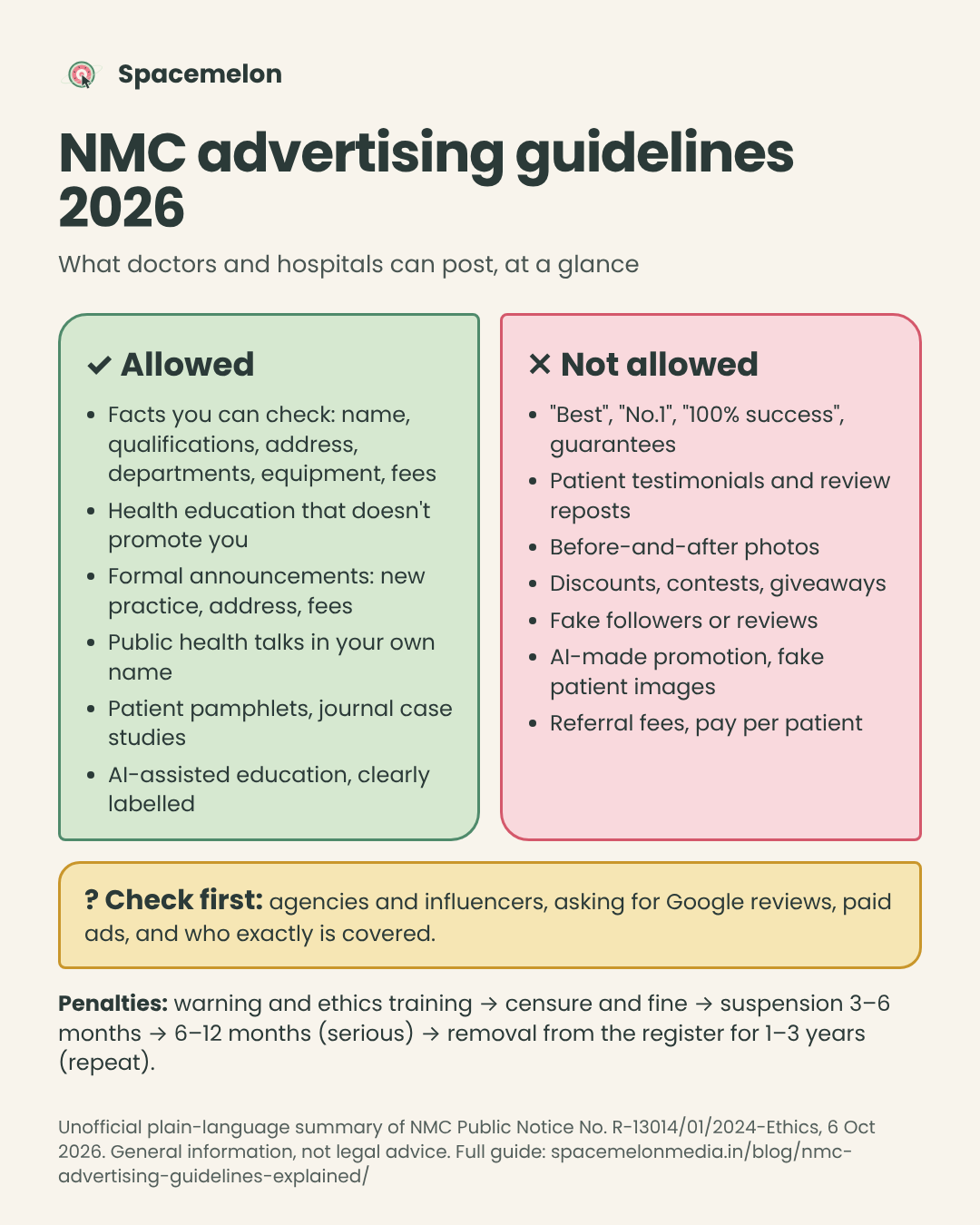
Save and share the one-page version
A single image of the do's and don'ts that you can save to your phone or send to your team. It carries the same “unofficial summary” label as this page.
Agencies, influencers and AI content
The two places where the notice is strictest, and least clear. From the notice
Agencies and influencers
- A practitioner shall not engage a third party for marketing medical services (8.1(ii)).
- Agency or platform pay must not be linked to individual patients (8.1(viii)).
- These two read in different directions, so read them strictly and ask your State Medical Council in writing.
AI-made content (7.2)
- Prohibited AI promotional campaigns for commercial interest
- Prohibited AI patient images, testimonials or endorsements
- Allowed Other AI content, with a clear AI source mark
What are the penalties? A chart
Penalties are graded: they get heavier with each violation and with how serious it is. A show-cause notice comes first. From the notice (10, 11)
See the chart as a table
| Stage | Penalty | Length |
|---|---|---|
| First violation | Warning and ethics training | None |
| Second violation | Censure and a fine | None |
| Third violation | Suspension | 3 to 6 months |
| Serious violations | Suspension | 6 to 12 months |
| Repeat offences | Removal from the register | 1 to 3 years |
What happens, step by step
What can doctors and hospitals still create and market?
The guidelines stop self-promotion, not communication. The safest content is useful to a stranger even if they never visit you.
✓ Clearly fine
- Health education: symptoms, prevention, myths and facts
- A website with departments, equipment, accreditation, doctor directory, fees
- An accurate Google Business Profile: hours, address, services
- Public talks, awareness programmes, patient pamphlets
- Formal announcements: new address, fees, absence
- Facility and process visuals with no patients in them
? Check with your council
- Hiring any agency or freelancer
- Paid search ads or sponsored posts
- Asking patients for Google reviews
- Free health camps
- Practitioners outside the NMC register, such as AYUSH
× Not allowed
- Testimonials, review reposts, patient stories
- Before-and-after photos
- “Best”, “No.1”, guarantees
- Offers, discounts, giveaways
- Paid influencers, per-patient agency pay
- Fake followers or reviews
The idea behind all of it: let facts and usefulness do the work adjectives used to do. A hospital that lists its accreditation, equipment, emergency line and fees, and teaches people something every week, becomes the one people recognise, without a single banned claim.
See a sample month of compliant posts
- Reel: five signs of dehydration
- Post: emergency number and departments
- Story: myth or fact
- Carousel: what to bring to a first visit
- Reel: equipment tour, no patients
- Post: consultation fee notice
- Explainer: how a common test works
- Greeting on a medical day
- Story: seasonal health tip
- Awareness-camp announcement
- Doctor talk on public health
- Post: holiday opening hours
How Spacemelon can help hospitals and clinics, within the rules
People ask how to “get around” rules like these. We do not, and neither should you: the notice says a third party cannot be used to do indirectly what is banned directly, and the responsibility stays with you. What we do is build content and visibility that fits inside them.
What we will not do
- ×Patient testimonials, review reposts or before-and-after posts
- דBest”, “No.1” or guaranteed-result claims
- ×Bought followers, likes or reviews
- ×Influencer campaigns or per-patient pay
- ×AI-made promotional videos or fake patient images
- ×Offers, giveaways or discounts for medical services
An honest note for individual doctors. Clause 8.1(ii) appears to bar a practitioner from engaging a third party for marketing medical services. Until your State Medical Council confirms what is allowed for you, we work with hospitals and institutions, and with doctors on educational material that you review and publish in your own name.
Frequently asked questions
Can hospitals advertise in India?
Yes, within limits. Hospitals can share factual, checkable information such as name, location, contact details, departments, equipment, accreditation, emergency services and fees. Claims of being better than others, and guarantees, are not allowed.
What can doctors post on social media under the NMC rules?
Health education that does not promote them, formal announcements such as a new address or fees, public health talks in their own name, and factual hospital information. Electronic posts should show the doctor's name, qualifications and registration number.
Can doctors advertise in India?
Within limits. Doctors and hospitals can share factual, verifiable information, health education that does not promote them, and formal announcements. Superlatives, guarantees, patient testimonials, before-and-after photos, offers and paid promotion through third parties are not allowed.
Can doctors post on Instagram and other social media?
Yes, for health education, factual hospital information and formal announcements. The guidelines apply to every medium, so a post that promotes a doctor or hospital, shares a patient review or shows before-and-after results is not allowed.
Can doctors share patient testimonials or reviews?
No. A practitioner must not request or share patient testimonials, endorsements or reviews for promotion on social media, and fake, paid or misleading reviews are banned.
Are before-and-after photos allowed?
Not for promotion. They are allowed only for scientific or educational use, published with anonymised patient consent. Consent alone does not make a banned practice allowed.
Can doctors use AI-generated content?
AI-generated promotional campaigns for commercial interest are prohibited. Other AI content must carry a clear AI source mark, and AI must not create patient images, testimonials or endorsements.
Can doctors use influencers or marketing agencies?
Responsibility stays with the doctor or hospital, a practitioner must not engage a third party for marketing medical services, and agency pay must not be tied to individual patients. Confirm with your State Medical Council before engaging anyone.
What are the penalties for breaking the NMC advertising rules?
After a show-cause notice: a warning and ethics training, then censure and a fine, then suspension of 3 to 6 months, 6 to 12 months for serious violations, and removal from the register for 1 to 3 years for repeat offences. Appeals go to the NMC within 60 days.
Do the guidelines apply to hospitals as well as doctors?
Yes. They apply to hospitals and clinical establishments as well as registered medical practitioners in the National or a State Medical Register.
Can a doctor or hospital run Google Ads or sponsored posts?
Search ads and sponsored posts are covered like any other medium. Anything promotional must stay factual, with no superlatives, guarantees, offers or testimonials. Because of the restriction on engaging third parties, check with your State Medical Council before paying anyone to run them.
Do the guidelines cover AYUSH doctors and dentists?
The notice defines practitioners by the National or a State Medical Register and does not clearly say whether practitioners on other registers are covered. They should check with their own council.
Are the guidelines in force now?
Yes. The notice dated 6 October 2026 takes effect immediately.
Where can I read the official notice?
It is Public Notice No. R-13014/01/2024-Ethics, dated 6 October 2026, from the NMC Ethics and Medical Registration Board. Look for it under What's New on the NMC website.
NMC guidelines reference: clause table, Hindi summary and glossary
Clause-by-clause table
| Topic | What the notice says | Clause |
|---|---|---|
| What counts as advertising | Any communication that promotes a doctor or hospital, in any medium, including social media, WhatsApp, influencers, search ads, sponsored posts and AI-made content | 3.2, 3.5 |
| Agencies and influencers | Using one does not remove responsibility for content authorised, paid for or knowingly allowed | 4.4 |
| Third parties | A practitioner shall not solicit patients, promote services through self-promotion, or engage any third party for marketing medical services | 8.1(ii) |
| Agency payment | Must not be linked to procuring or referring individual patients | 8.1(viii) |
| Claims | No “Best”, “No.1”, “100% success”, “painless” or “guaranteed cure” unless objectively verifiable; rankings and awards must be independently verifiable | 8.1(iii), (ix) |
| Reviews and testimonials | No fake, paid or misleading reviews; no requesting or sharing patient testimonials, endorsements or reviews for promotion on social media | Expl. V to 3.2, 8.1(xi) |
| Before-and-after | Not allowed, except scientific or educational use published with anonymised patient consent | 8.1(v) |
| Patient consent | Consent alone does not make a banned practice allowed; where needed it must be specific, informed and documented; identities hidden | 6.1 to 6.4, 7.4 |
| AI content | AI-generated promotional campaigns for commercial interest are prohibited; other AI content must carry an AI source mark; no AI patient images, testimonials or endorsements | 7.2 |
| Fake engagement | No buying followers, likes, reviews or comments; no manipulating search rankings or algorithms to mislead | 8.1(xii) |
| Offers | No discounts, contests, coupons, gifts, cashbacks or free procedures that encourage unnecessary treatment | 8.1(x) |
| Referral fees | No commission, rebate or lead-generation fee tied to referring patients | 8.1(vii) |
| Allowed | Factual hospital information, health education that does not promote the doctor, practice announcements, public fee declarations, patient pamphlets, lectures in the doctor's own name | 5.1, 8.2, 8.3, 9.1 |
| Penalties | Graded: warning and ethics training; censure and fine; suspension of 3 to 6 months; 6 to 12 months for serious violations; removal for 1 to 3 years for repeat offences. Show-cause notice first; appeal to the NMC within 60 days | 10, 11 |
सार हिंदी में
6 अक्टूबर 2026 को राष्ट्रीय चिकित्सा आयोग (NMC) ने डॉक्टरों और अस्पतालों के विज्ञापन व सार्वजनिक संवाद के लिए दिशानिर्देश जारी किए। ये तुरंत लागू हैं और हर माध्यम पर लागू होते हैं, जैसे सोशल मीडिया, WhatsApp, वेबसाइट और विज्ञापन।
अनुमति है
- तथ्य-आधारित जानकारी: नाम, योग्यता, पता, विभाग, उपकरण, शुल्क
- स्वास्थ्य शिक्षा, जो अपने प्रचार के लिए न हो
- प्रैक्टिस की औपचारिक सूचना
अनुमति नहीं है
- “सर्वश्रेष्ठ”, “नंबर 1”, “100% सफलता” जैसे दावे
- मरीज़ों की समीक्षा या प्रशंसा-पत्र
- पहले-और-बाद की तस्वीरें
- छूट, कूपन, उपहार, प्रतियोगिता
- फर्जी फॉलोअर्स या रिव्यू
- AI से बना प्रचार
उल्लंघन पर सज़ा चेतावनी से शुरू होकर बार-बार उल्लंघन करने पर 1 से 3 साल के लिए पंजीकरण रद्द होने तक हो सकती है। यह सामान्य जानकारी है, कानूनी सलाह नहीं। आधिकारिक दस्तावेज़ पढ़ें और संदेह होने पर अपनी राज्य चिकित्सा परिषद से पूछें।
Glossary and source
- Registered Medical Practitioner (RMP)
- A doctor listed in the National Medical Register or a State Medical Register.
- Show-cause notice
- A formal letter asking you to explain why action should not be taken against you.
- Censure
- A formal official reprimand.
- Testimonial or endorsement
- A statement from a patient or other person praising a doctor or hospital, used to attract others.
- Self-promotion
- Communication whose purpose is to make a stranger more likely to choose you over another doctor.
- AI source mark
- A clear label saying that content was made with AI.
Source
National Medical Commission, Ethics and Medical Registration Board, Public Notice No. R-13014/01/2024-Ethics dated 6 October 2026, “Guidelines on Ethical Advertising and Public Communication by Hospitals/Medical Institutions and Registered Medical Practitioners”. Official site: nmc.org.in.
We summarised the notice to make it readable and added our own suggestions where marked. If you spot an error or the NMC issues a clarification, write to [email protected] and we will fix this page. Last checked 19 October 2026.